
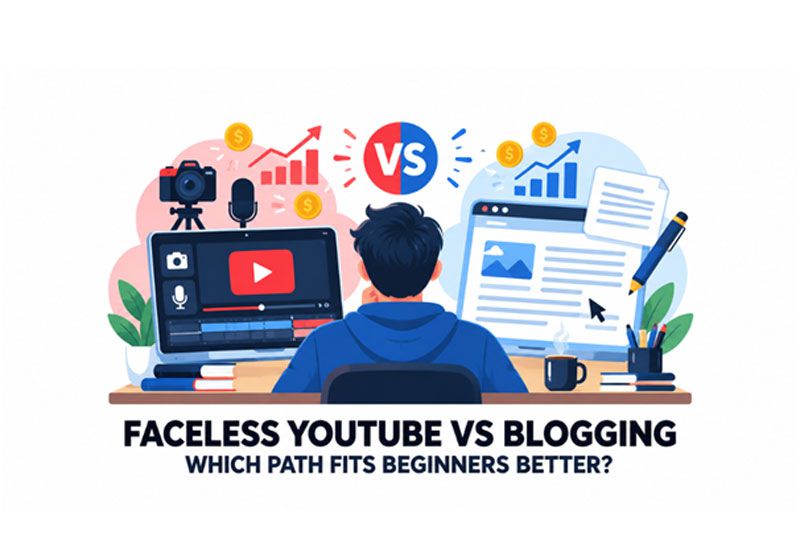
Both of these work. Both are difficult. And anyone telling you one is obviously better has usually only tried the one they are recommending.
I should declare an interest before going further: I run faceless YouTube channels, which makes me exactly the wrong person to ask for an unbiased verdict. So rather than deliver one, this compares the two honestly on the axes that actually decide the outcome, including several where blogging is clearly the better choice.
The comparison
| Faceless YouTube | Blogging | |
| Startup cost | Near zero | Near zero, plus domain and hosting |
| Skills to begin | None required | Writing |
| Time per piece | 4 to 6 hours | 2 to 4 hours |
| First traffic | Possible from video one | Typically months |
| Monetisation threshold | 1,000 subscribers plus 4,000 watch hours | Much lower, and affiliate from day one |
| Who owns it | YouTube | You |
| Where AI helps most | Production | Drafting |
| Main structural risk | Platform dependence | Search disintermediation |
Where blogging genuinely wins
Four things, and they are not minor.
You own it. A domain and its content belong to you. A YouTube channel is a tenancy, and the landlord can change the terms, demonetise you or remove the channel. That asymmetry is real and it is the strongest argument for blogging.
Faster to produce. A competent post takes two to four hours. A video takes four to six. Over a year that is a meaningful difference in output for the same effort.
No monetisation gate. YouTube requires 1,000 subscribers plus either 4,000 public watch hours in twelve months or 10 million Shorts views in 90 days before advertising revenue begins, and those thresholds rise for new applicants in February 2027. A blog can run affiliate links from the first post and display advertising at far lower traffic.
Editable. A post that turns out wrong can be corrected. A published video is effectively fixed, and updating it means making another one.
If you write comfortably and dislike the idea of being at a platform’s discretion, those four points are a serious case.
What changed for blogs, and why it hits beginners hardest
Here is the development that has to be part of this comparison in 2026, and it is not a small one.
Roughly 68 percent of Google searches now end without a click, according to SparkToro’s tracking of the first four months of 2026, up from around 60 percent in 2024. AI Overviews trigger on close to half of tracked queries, a substantial year-on-year increase, and Bain’s research estimated organic web traffic down 15 to 25 percent across many sectors as a consequence.
The important detail is that the damage is not evenly spread. Zero-click rates run around 74 percent on informational queries and roughly 31 percent on transactional ones. Definitional posts, basic how-to guides and roundups of publicly available facts are absorbed most completely, because a summary can replace them entirely.
Now consider what a beginner blogger naturally writes. Explainers. How-to guides. “What is X” posts. Exactly the category being absorbed.
That is why “is blogging dead” gets contradictory answers. Blogging is not in general decline. One survey of over 300 bloggers found that sites publishing first-hand experience, original research and genuine expertise saw traffic rise by 30 to 80 percent since 2024, as content farms were filtered out around them.
So the honest version is narrower and more useful than either headline. Blogging works if you can publish something an AI summary cannot replace: original testing, your own data, a real opinion, first-hand experience. It does not work if your plan is to explain well-documented things clearly, which is what most beginners start with and what most beginner advice still recommends.
Where YouTube genuinely wins, and what it costs you
Distribution without authority. This is the significant one. A new blog earns nothing from Google for months because it has no authority. A new channel can be shown to viewers from its first upload, because YouTube’s recommendation system tests content on audiences rather than waiting for you to earn a ranking. For a beginner with no existing audience, that difference is substantial.
No writing requirement. A blog requires you to write well. A channel requires you to explain well, which is a different and more common ability, and AI now covers the drafting.
Higher value per view in the right subject. What a channel earns per thousand views is set largely by subject and audience location, and for commercially valuable subjects it compares favourably with display advertising on a blog.
And the cost, stated plainly: you are a tenant. Policies change, monetisation can be withdrawn, and channels are occasionally removed. Whether the model remains viable as the platform tightens its rules is a live question rather than a settled one, and anyone building here should know that going in.
Which suits which beginner
Choose blogging if you write easily, you have first-hand expertise or original data that a summary cannot replace, and platform independence matters to you. Also choose it if your subject is genuinely better as text, which reference material, code and anything involving tables usually is.
Choose YouTube if you have no audience and no authority and need distribution you have not earned, if explaining out loud comes more naturally than writing, or if your subject benefits from demonstration.
Choose neither yet if you are hoping either will pay quickly. Both are measured in months before anything arrives, and a majority of people who start either do not continue.
The combination worth considering is one as the primary effort and the other as repurposing, since a script and a post are close relatives. But run one properly first. Two half-built projects is the most common way beginners end up with nothing.
The honest close
The question is usually framed as which model is better, and that framing is the problem. They have different failure modes.
Blogging’s risk is that your distribution channel is being disintermediated by the company that owns it. YouTube’s risk is that you do not own your channel at all. Neither is safe, and choosing between them is choosing which risk you would rather carry.
What both reward is the same thing: something genuinely yours, published consistently for longer than feels reasonable. That was true before AI and it is more true now, because everything short of it can be generated by anyone.
Frequently asked questions
Is blogging dead in 2026?
No, but it has narrowed. Around 68 percent of Google searches now end without a click, and informational content is absorbed most heavily by AI summaries. Blogs publishing original research, first-hand experience and genuine expertise have continued to grow. Blogs explaining well-documented topics clearly have not.
Which is cheaper to start?
Both are close to free. A blog requires a domain and hosting, a modest annual cost. A faceless channel requires neither, though it needs more hours per piece of content. Neither cost is meaningful enough to decide the question.
Which reaches monetisation faster?
Blogging, structurally. There is no subscriber or watch-hour threshold, so affiliate income can begin with the first post. YouTube requires 1,000 subscribers plus 4,000 public watch hours or 10 million Shorts views before advertising revenue starts, and those figures rise for new applicants in February 2027.
Can I do both at once?
Eventually, and they repurpose well, since a script and a post are closely related. But building both from zero simultaneously is how beginners end up with two abandoned projects. Run one properly for six months first, then add the second as repurposing rather than as a second effort.
Which is safer in the long term?
Neither, and they fail differently. A blog is yours but depends on a search channel that is actively reducing clicks to publishers. A channel has distribution but belongs to the platform. Choosing between them is really choosing which of those two risks you would rather hold.
