
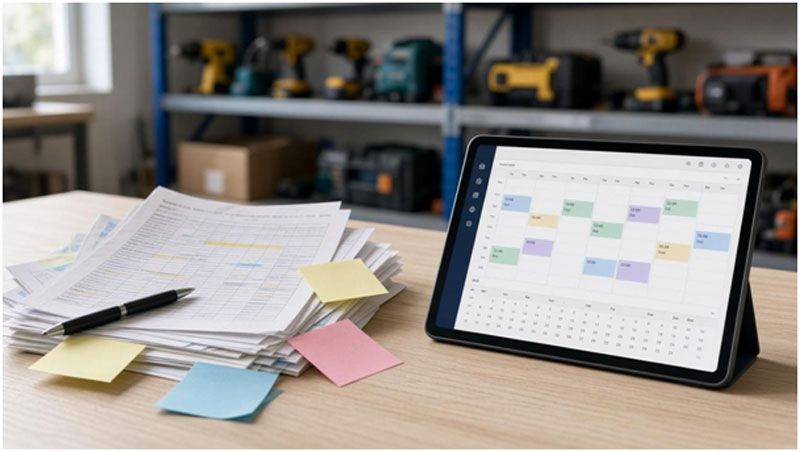
Almost every rental business starts the same way. A handful of items, a notebook or a shared spreadsheet, and an owner who knows exactly where everything is. It works, and for a while it works well.
Then the business grows. Ten items become a hundred. One location becomes two. A part-time helper becomes a team of five. Somewhere along the way the spreadsheet that once felt like a superpower starts causing problems that nobody planned for.
If you run a party rental company, a tool hire shop, a camera and AV rental, or a construction equipment yard, this post is for you. Let us look at the warning signs, what they cost you, and how to move to something better without turning your business upside down.
Why Spreadsheets Work at First
To be fair, spreadsheets are brilliant early on. They are free, flexible and everyone knows how to use them. You can track items, customers and dates in a few columns, and add a formula or two for totals.
The trouble is that a spreadsheet does not know anything about your business rules. It does not know that a generator cannot be in two places at once, that a pressure washer needs servicing every 50 hours, or that a customer with an unpaid invoice should not get another booking. You have to remember all of that yourself, and as volume grows, memory fails.
Sign 1: Double Bookings Keep Happening
This is usually the first and most painful sign. Two staff members take bookings for the same item on the same weekend, each looking at a slightly different version of the sheet. One customer turns up and the item is not there.
Every double booking costs more than a refund. It costs a review, a referral and sometimes a long-term client.
Sign 2: You Cannot Answer “Is It Available?” Quickly
When a customer calls and asks whether you have three scissor lifts free next Thursday, how long does it take to answer? If you need to scroll, filter, check a WhatsApp group and ring the warehouse, you are losing bookings to competitors who can answer instantly or let customers check online.
Sign 3: Maintenance Is Reactive, Not Planned
In many spreadsheet-run businesses, equipment gets serviced when it breaks. That leads to failures on customer sites, safety risks and expensive emergency repairs. Planned maintenance needs reminders tied to usage, and spreadsheets do not send reminders on their own.
Sign 4: Invoicing Takes Hours Every Week
If someone on your team spends Friday afternoon copying rental dates into invoice templates, calculating late fees by hand and checking who has paid, that is time not spent on sales or customer service. It also invites errors that customers notice.
Sign 5: You Do Not Know Which Items Make Money
Ask yourself which ten items earned the most last quarter, and which ten barely left the shelf. If you cannot answer within a minute, you are making purchasing decisions blind. You might be buying more of something that looks popular but actually earns little after repairs.
Sign 6: Only One Person Really Understands the System
Spreadsheets tend to grow strange tabs, colour codes and formulas that only their creator understands. When that person is on holiday or leaves, the business struggles. That is a real operational risk.
What These Problems Actually Cost
It is easy to shrug these issues off as small annoyances, but they add up:
- Lost revenue from bookings you could not confirm quickly
- Refunds and discounts after double bookings
- Repair bills that planned maintenance would have avoided
- Admin hours spent on manual invoicing and chasing payments
- Poor buying decisions made without utilisation data
The U.S. Small Business Administration’s guide to managing business finances stresses that good records are the foundation of good decisions. For a rental company, good records mean knowing what each asset is doing every day.
What to Look For in a Better System
When you start looking at alternatives, it helps to know what actually matters for rental operations, rather than general business tools that need heavy customising.
Real-time availability
The system should block an item the moment it is booked, across every staff member and location, so double bookings simply cannot happen.
Online booking
Customers increasingly expect to check availability and reserve online, the same way they book a hotel or a table. Even if you still take phone bookings, an online option captures customers outside office hours.
Maintenance scheduling
Look for service reminders based on rental days or hours used, and the ability to mark items unavailable while they are in the workshop.
Automated contracts and invoices
Rental agreements, deposits, damage waivers and invoices should generate from the booking itself, with no retyping.
Reports that answer real questions
Utilisation by item, revenue by category, overdue returns and outstanding payments should be a click away.
As this piece on why good management software is crucial to your business explains, the right tool cuts errors because everyone works from the same data instead of separate copies.
Making the Switch Without Chaos
Moving off spreadsheets can feel daunting, but it does not need to be a big-bang change. A sensible approach looks like this:
- Clean your data first. List every item with a unique ID, category, purchase date and condition. Archive anything you no longer rent out.
- Pick a quiet week. Avoid your busiest season for the switch.
- Import, then test. Load your inventory and upcoming bookings, then run a few test bookings end to end.
- Train the team together. A short session where everyone books, checks out and returns an item builds confidence fast.
- Run both for a short time. Keep the old sheet as read-only for a couple of weeks so nobody panics.
There are several tools on the market built specifically for this job. Dedicated rental management software tends to handle availability, maintenance and billing out of the box, which is usually faster to set up than bending a generic CRM or accounting tool to fit rental workflows.
The Bottom Line
Spreadsheets are a great way to start a rental business and a poor way to scale one. If you are seeing double bookings, slow answers to availability questions, missed maintenance or hours lost to invoicing, those are signals that your operations have outgrown the tool. Switching to a system designed for rentals is not about chasing technology for its own sake. It is about giving your team more time, your customers a smoother experience and yourself clearer numbers to grow the business on.
