Email marketing continues to be one of the most effective ways for businesses to communicate, but its success greatly relies on whether emails actually land in the recipient’s inbox. A key element affecting deliverability is accurate email authentication, which is where SPF comes into play. The Sender Policy Framework (SPF) tester ensures that your domain is authorized to send emails, helping to prevent spoofing and enhancing credibility with email services. This valuable tool verifies your domain’s email authentication configuration, confirming that your messages are dispatched from authorized servers instead of being marked as spam. By swiftly detecting and resolving SPF-related issues, you can dramatically enhance email deliverability, safeguard your sender reputation, and improve inbox placement in just a matter of minutes.
In this detailed guide, we will delve into what SPF is, its importance, how SPF testers function, and how you can leverage them to enhance your email deliverability quickly.
SPF, or Sender Policy Framework, is a protocol used for email verification aimed at identifying and stopping email spoofing. It enables domain owners to indicate which mail servers are permitted to send messages on their behalf.
This specification is implemented via a DNS record referred to as an SPF record. Upon receiving an email, the recipient’s mail server verifies the sender’s authorization by consulting this SPF record.
If your SPF record isn’t set up correctly, there’s a higher chance your emails will be marked as spam or not delivered at all.
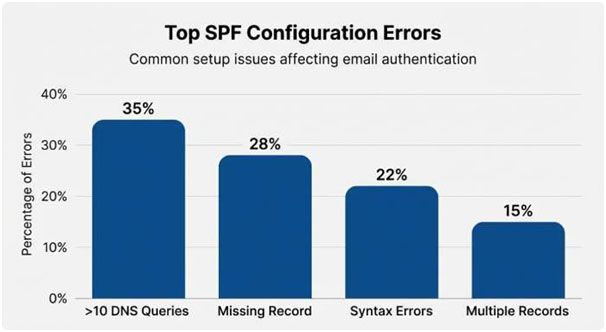
An SPF tester is a utility designed to evaluate your domain’s SPF record for correct setup. It identifies mistakes, misconfigurations, and adherence to standard practices. By examining your SPF record, this tool helps ensure it is accurately configured and error-free, pinpointing issues such as syntax errors, excessive DNS queries, or unauthorized senders that could hinder email delivery.
SPF testers assist in pinpointing problems, enabling you to resolve them prior to affecting your email deliverability.
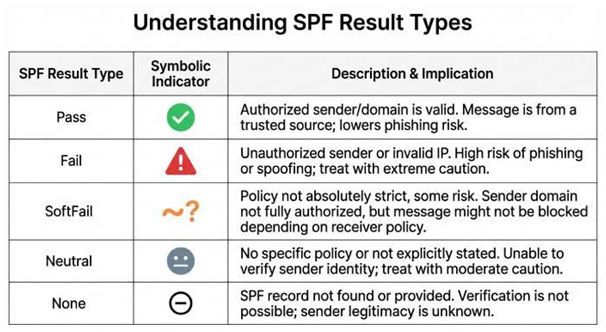
When an email is dispatched from your domain, the server that receives it looks up the SPF record in your domain’s DNS. It verifies whether the sending IP address is permitted. Depending on this assessment, the email can be classified as passed, failed, or given a soft fail designation.
The SPF authentication process starts when the receiving mail server consults the sender’s domain SPF record in DNS to confirm the authorization of the sending IP address. This validation results in the email being labeled as pass, fail, or another category, influencing its delivery status.
SPF results determine the authorization status of an email sender, categorizing it into various outcomes: Pass means the sender is authorized, Fail indicates the sender lacks authorization, SoftFail suggests a degree of suspicion without outright rejection, Neutral shows that there is no strict policy in place, and None implies that no SPF record exists. These results assist receiving servers in making informed choices about whether to accept, flag, or decline incoming emails according to the domain’s authentication policies.
Testing your SPF is straightforward and quick:
Minor errors can significantly impact how your emails perform.
An efficiently configured SPF record is both brief and powerful.
The “-all” directive rigorously upholds your SPF policy by denying any unauthorized senders. In contrast, “~all” (soft fail) is beneficial for testing purposes. Transitioning to “-all” once your settings are reliable enhances security. Implementing the “-all” directive in your SPF record ensures strict validation by rejecting emails from unapproved sources. After thorough testing of your SPF setup, moving from “~all” to “-all” greatly fortifies your domain’s security and the authenticity of your emails.
Having SPF is insufficient on its own. To ensure optimal email deliverability, pair it with:
SPF testers offer instantaneous feedback, enabling you to swiftly pinpoint and address any problems that could hinder deliverability. By assessing your domain’s setup in real time, these tools provide immediate insights. They rapidly detect mistakes and misconfigurations, helping you rectify issues before they impact your email delivery.
By properly configuring settings, SPF testers contribute to:
SPF testers play a crucial role in ensuring that your domain isn’t misused, thereby safeguarding your brand’s reputation and maintaining customer trust. By blocking unauthorized senders from using your domain, these tools enhance the integrity of your brand and foster confidence among your audience.
SPF flattening is the process of substituting “include” directives with specific IP addresses to minimize DNS queries. This method is particularly beneficial when your SPF record is nearing the 10-lookup threshold.
Nonetheless, it is essential to keep it updated regularly since third-party IP addresses can change.
Ongoing oversight guarantees the efficiency of your SPF record.
Numerous companies utilize various platforms such as CRM systems, marketing applications, and support tools for their email communications. It’s crucial to incorporate each of these services into your SPF record to prevent issues with authentication. When employing multiple third-party services for sending emails, ensuring they are listed in your SPF record is essential for maintaining proper authorization. Neglecting to do this may result in authentication errors, which can adversely affect email delivery rates.
Even if your SPF record is accurate, emails might still be routed to the spam folder due to:
This typically suggests there are alignment problems between the SPF record and the “From” domain. Make sure your domains are correctly aligned for DMARC compliance. When an SPF check passes but DMARC fails, it often points to a misalignment between the sending domain and the “From” address. To resolve this, ensure that the domain in your SPF record corresponds with the domain in your email headers, allowing DMARC to validate it properly.
Numerous trustworthy tools exist for the purpose of testing and verifying SPF records.
Some notable examples are MXToolbox, Kitterman SPF Validator, and DMARC Analyzer.
The AutoSPF SPF tester is a simple and effective tool that can boost your email delivery rates in just minutes. By checking that your SPF record is correctly configured, AutoSPF not only improves your chances of landing in the inbox but also strengthens your domain’s security and reputation.
Nonetheless, SPF is merely a component of a comprehensive email authentication approach. For optimal outcomes, it’s advisable to use SPF in conjunction with DKIM and DMARC, keep an eye on your settings, and remain informed about the latest best practices.
In the highly competitive digital environment of today, even minor enhancements in deliverability can translate into significant increases in engagement and conversions. Start utilizing an SPF tester now to take charge of your email marketing success.
Most marketing teams aren't failing because they lack data. They're failing because they can't act…
Xerox first introduced it around the mid-1970s. The need came up because the management activities…
Investing in the forex market may look to be a dangerous game. With some worthwhile…
The coronavirus outbreak has drastically changed the way we live our lives. Yes, that's absolutely…
Sales and marketing teams help attract, convert, and retain customers to ensure an organization’s long-term…
Are you an owner of a small business who’s trying to come up with ways…